
In Vitro Solutions that Mimic the Physiology of the Human Liver
Start with our trusted primary human hepatocytes, then extend your studies with TruVivo® for long-term function and more comprehensive, human-relevant physiological insight.
Primary Human Hepatocytes
Empower your drug metabolism and hepatic research with our reliable primary human hepatocytes: induction-qualified, spheroid-qualified, long-term plateable, and single or pooled donor lots.
TruVivo® 2D+ Hepatic System
Enable long-term studies with a flexible, easy-to-use in vitro hepatic system that maintains structural integrity and biological function for more than 2 weeks.
Primary Human Hepatocytes
LifeNet Health® LifeSciences is the only provider in the world that services the full donation lifecycle—from initial consent and recovery to transport, downstream isolation, and rigorous cell characterization. This end-to-end infrastructure enables us to offer primary human hepatocytes of the highest quality for use in applications including intrinsic clearance, CYP induction, drug-drug interactions, and other metabolism and toxicity studies.
- Directly, ethically sourced with broad donor consent
- Comprehensive medical and social histories
- Reviewed by a board-certified pathologist for MAS & fibrosis scoring
- Induction-qualified lots to support consistent induction performance
- Spheroid-qualified lots for 3D culture applications
- 20-donor suspension pooled lots for high-throughput intrinsic clearance studies
- Demonstrated phase I and II enzyme activity
- HLA typed and genotyped
- Supported by protocols, media recommendations, and expert technical assistance
TruVivo® 2D+ Hepatic System
TruVivo is an advanced 2D+ hepatic platform that bridges the gap between traditional cell culture and complex 3D models. Built to fit seamlessly into existing hepatocyte workflows, TruVivo combines extended functionality with ease of use and experimental flexibility. Its 3D-like architectural integrity maintains stable metabolic activity over extended timeframes, enabling critical low-clearance and long-term induction studies. Available via ready-to-use-in-house kits or expert services, TruVivo delivers human-relevant data that scales to your laboratory’s unique demands.
Extended Culture Longevity
- Stable morphology and stable phase I and II enzyme activity for > 2 weeks
- Maintains hepatocyte phenotype and cell-cell interactions
- Supports long-term induction and repeated dosing studies
Ease of Adoption
- Compatible with standard hepatocyte workflows and assay formats
- Available as ready to use kits or supported through our In Vitro Assay Services
- No need to redesign intrinsic clearance or CYP induction protocols
Experimental Flexibility
- Supports a wide range of ADME and mechanistic applications
- Adaptable to fit user and assay needs
- Enables deeper investigation without switching models
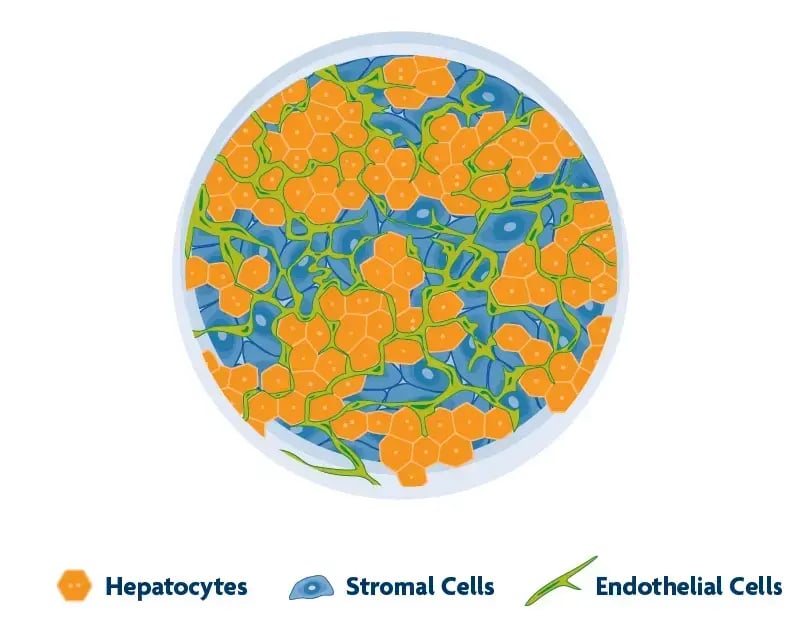
This schematic representation of TruVivo shows a top view of the self-assembled, multicellular hepatocyte colonies integrated among the mixed feeder cell population.
Applications Enabled by TruVivo®
Quantitative Induction & DDI Risk Assessment
Predict induction with mRNA responses 2 to 20 times higher than conventional monocultures. This superior dynamic range enables accurate parameter estimation and quantitative translation to clinical outcomes for critical CYP2C, UGT, and P-gp pathways. Confidently triage compounds and reduce the need for expensive, unnecessary clinical interaction studies.
Metabolic Stability for Low-Turnover Compounds
Quantify human hepatic clearance for highly stable compounds and improve assay success rates, reducing "insufficient turnover" results from 40% in standard suspension models to just 4%. Achieve high-fidelity clearance predictions across diverse chemotypes to inform dosing and risk assessments with greater certainty.
Advanced Non-CYP Clearance (Aldehyde Oxidase)
Assess challenging non-CYP pathways with stable AO activity sustained up to 10-fold higher than competing models for 14+ days. This metabolic endurance enables accurate clearance predictions for slowly metabolized compounds that standard 4-hour assays fail to capture. Use these high-fidelity data to bridge translational gaps and better identify clinical drug interaction risks.